Skip to content Skip to footer

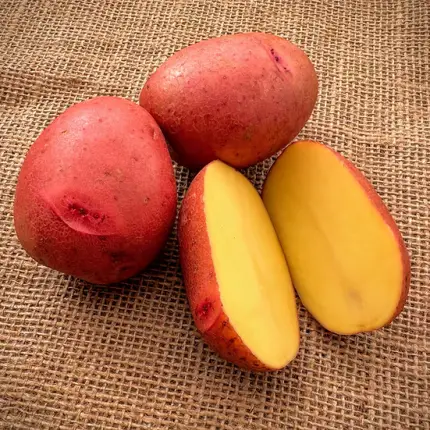
Yukon Gold Seed Potatoes Bulk

~Bulk Yukon Gold Seed Potatoes (available in 50#)

  • Early Maturity
  • Yellow Skin
  • Yellow Flesh
SKU: N/A Categories: , , Product ID: 22950

Description

What’s Included: bulk seed potatoes

  • Blue Tag Certified
  • Grade A

At the time of receiving, check that the product is correct and in good condition. Notify us within 3 days after receiving if any issue arise in that time frame.
Remove the wrapping and downstack the pallets to ensure the product does not heat up which causes spoilage. Make sure to have air flow on the onion sets.
Additional information

Weight N/A
Size

50 Pound Bag

Origin

Released jointly by Agriculture Canada and the University of Guelph,
Guelph, Ontario, Canada in 1981. Yukon Gold was selected from
a cross between W5279-4,Katahdin and Norgleam.
It was tested under the pedigree G6666-4Y.

Tubber

Tubers are oval,slightly flattened, with yellow-whiteskin and light yellow tuber flesh.
It has shallow, uniquely colored pink eyes.distinguishIing Yukon Gold
from other yellow-skinned, yellow-fleshed cultivars

Characteristics

Yukon Gold has medium-early maturity,moderate yields,
moderate specific gravity and relatively attractive tuber type. Plants
are medium-large to large and upright. Stems are purplish but are more green in
the upper portion of the plant. Leaf petioles extend downward. Nodes are not
swollen. Leaves have a distinct terminal leaflet with four pairs of primary
leaflets which are largest near the terminal leaflet. Secondary leaflets vary
from two on lower leaves to 6-8 on upper leaves, usually in pairs. The number of
tertiary leaves also increases from lower to upper leaves. Flowers are violet to
light-violet with yellow anthers.

Strengths and Weaknesses

Yukon Gold is resistant to mild mosaic, moderately resistant
to leafroll virus and susceptible to virus Y, common scab .
In some growing areas, hollow heart and internal heat necrosis may be a problem.
Yukon Gold retains the yellow flesh color when baked, boiled or french-fried.
The attractive tubers are well suited for fresh marketing.
Plant establishment is irregular, particularly from basal seed pieces.
Pre-cut or whole seed is used in some areas to improve plant stands

Summary of Plant Characteristics

Purpose — fresh market – boil and bake, possible for French frying
Maturity — early to mid season similar to Superior; determinate
Vine — medium, very erect, some tendency to spread
Flowers — violet to light violet; low frequency
Leaves — olive green, moderately shiny
Stem — 1 to 3 per plant
Root — moderately compact
Emergence — rapid
Set — few tubers set high
Bulking — early and very rapid
Dormancy — medium to long
Eyes — shallow, pinkish; few and not well distributed
Tuber Color — light yellow flesh
Tuber Skin — yellowish white, smooth
Tuber Shape — slightly oval and flattened, width to length = 88
Yield — medium
Specific Gravity — medium-high, 1.080s
Storage — well, dry rot with rough handling, soft rot due to large lenticels
Glycoalkaloids — low-medium (4.6 mg/100g fresh weight)
Cooking Quality — good with dry texture after boiling or baking; chips dark
Internal Defects — hollow heart in larger tubers
Disease Reactions — moderately susceptible to common scab, PVY, early blight, dry rot, silver scurf and black scurf; susceptible to soft rots in storage
Pollution Sensitivity — susceptible to ozone damage (can induce early dying)
Herbicide Sensitivity — none to metribuzin

Availability

Spring Season: January through April